The ancient synergy between cards and stars
As a tarot practitioner, have you ever felt during a reading that the cards were whispering secrets about your client that you couldn’t quite decipher? That moment when The Star card appears alongside The Moon, and you sense a profound spiritual connection, but can’t pinpoint the exact cosmic relationship? What if you had access to a celestial map that could unlock these deeper layers of meaning?
For centuries, mystical practitioners have recognized the invisible threads connecting tarot and astrology. Today, we’re rediscovering how integrating the client’s natal chart can transform ordinary tarot readings into profoundly accurate spiritual consultations. Let’s explore how these two ancient systems complement each other and how modern technology can seamlessly bridge them together.
A Shared Historical Tapestry: When Cards Met Stars
The historical relationship between tarot and astrology stretches back to the Renaissance era, when esoteric scholars began mapping correspondences between the two systems. The Golden Dawn tradition, emerging in the late 19th century, formally established many of the astrological correspondences we recognize in tarot today . During this period, mystics like Arthur Edward Waite and Aleister Crowley systematically assigned planetary and zodiacal attributes to each major arcana card, creating a rich symbolic language that continues to influence contemporary practice.
The very structure of tarot echoes astrological principles: the 22 Major Arcana correspond to the 12 zodiac signs, 7 classical planets, and 3 elements beyond the traditional four; the 56 Minor Arcana reflect the decans and planetary movements; while the four suits mirror the astrological elements – Wands representing fire, Cups as water, Swords as air, and Pentacles as earth. This intricate mapping means that every tarot spread inherently contains astrological symbolism, whether the reader consciously recognizes it or not.
Why Your Client’s Natal Chart Matters in Tarot Reading
The Celestial Blueprint as an Interpretive Key
A natal chart – that cosmic snapshot of the sky at the exact moment of birth – provides what seasoned tarot readers call “the celestial context” for any reading . When you understand the client’s planetary placements, you move beyond generic interpretations into truly personalized guidance. Consider these powerful connections:
- The Moon’s position illuminates emotional patterns that might emerge when cards like The High Priestess or The Moon itself appear prominently
- Mercurial placements clarify communication styles that become relevant with Suit of Swords cards or The Magician
- Venusian influences color relationship dynamics that surface with the Suit of Cups or The Empress
- Martian energy manifests as action tendencies that align with Wands cards or The Tower
When you recognize that a client with Mars in Aries will express The Chariot card differently than someone with Mars in Cancer, your interpretations gain remarkable precision. Similarly, understanding whether someone has Saturn in their 7th house can completely transform how you frame the appearance of The Hierophant in a relationship spread.
Beyond Sun Signs: The Planetary Matrix
While popular astrology focuses heavily on Sun signs, the professional tarot reader benefits from considering the complete planetary matrix . The Ascendant (rising sign) modifies how the client presents themselves, relevant to cards like The Fool or Judgment. The Moon sign reveals emotional responses that illuminate cards like The Star or The High Priestess. Planetary aspects – the geometric relationships between celestial bodies – create narrative tension or harmony that mirrors the dynamic interactions between cards in a spread.
A client experiencing a Saturn return (when Saturn completes its orbit and returns to its natal position around ages 28-30 and 58-60) will express The Hermit card differently than someone under Jupiter’s expansiveness. Similarly, challenging aspects like squares or oppositions in the natal chart often manifest as tension between seemingly contradictory cards in a spread, while trines and sextiles typically appear as harmonious card combinations.
Practical Synthesis: Weaving Astrology Into Your Tarot Practice
The Integrated Reading Method
So how does this synthesis work in actual practice? Here’s a straightforward approach you can implement immediately:
- Begin with the houses: Identify the client’s pressing life areas by looking at which astrological houses are currently activated by transits. If a client has important planets in their 10th house of career, you’ll know to pay special attention to cards falling in positions relating to professional matters.
- Correlate the planetary rulers: When major arcana cards appear, note their planetary correspondences and check how those planets are placed in the client’s chart. The Tower (traditionally Mars) will express very differently for someone with Mars in diplomatic Libra versus Mars in assertive Aries.
- Note elemental emphasis: If a spread shows overwhelming fire element cards (Wands) but the client has a water-dominated chart (heavy Cancer, Scorpio, Pisces placements), you have immediate insight into the tension between their natural temperament and current circumstances.
- Consider lunar phases: The Moon’s current phase provides context for the emotional tone of any reading. A spread during the waxing moon might indicate developing situations, while the same cards during the waning moon could suggest resolution or release.
Case Example: Transforming a Challenging Reading
Imagine a client presents with relationship concerns. Their spread shows the Ten of Swords, The Tower, and Three of Cups – a confusing combination of devastation, upheaval, and celebration. Without astrological context, this seems contradictory.
Now consider their natal chart shows Venus in Gemini (need for mental connection in relationships) square Mars in Virgo (critical approach to action). Suddenly, the pattern clarifies: The Tower represents the breaking of their perfectionist relationship standards (Mars in Virgo), the Ten of Swords reflects the mental anguish of this breakdown (Venus in Gemini), and the Three of Cups suggests the social support that will help them rebuild.
This nuanced interpretation wouldn’t be possible without the astrological context.
Embracing Digital Assistance: The Modern Mystic’s Toolkit
Let’s be honest, memorizing all the astrological correspondences and calculating charts manually represents a significant time investment that many practicing tarot readers simply don’t have. This is where technology becomes the contemporary mystic’s best ally.
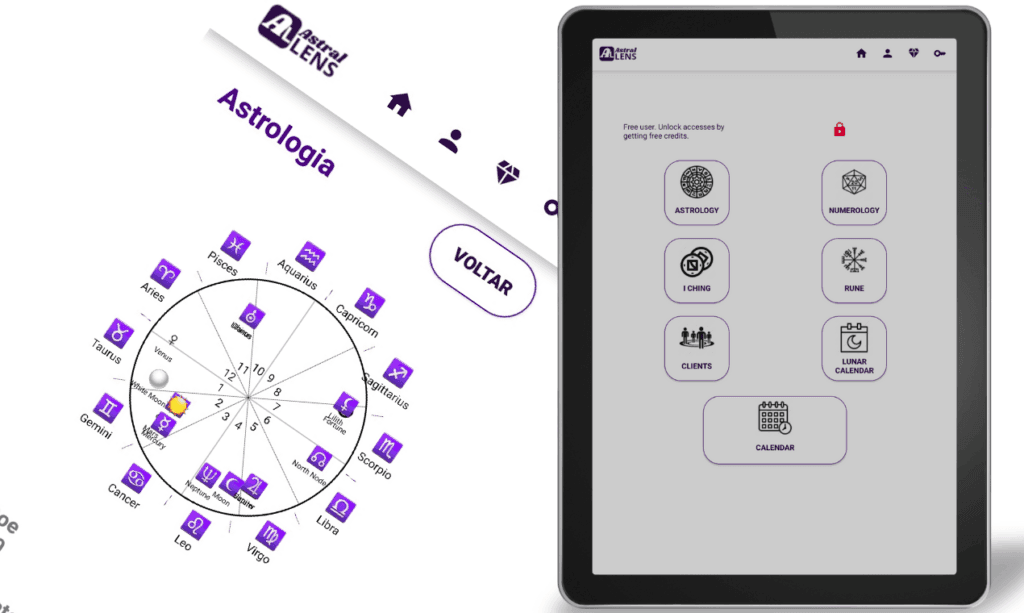
Astral Lens, our professional astrology application for Android devices, provides tarot practitioners with instant access to comprehensive natal charts and current planetary transits. Imagine having a client’s complete astrological profile at your fingertips during readings, without interrupting the sacred space to manually calculate charts. The app automatically generates the cosmic snapshot of any birth moment, identifying planetary positions, house placements, and significant aspects that might influence your tarot interpretations .
The integration works seamlessly: during tarot consultations, you can quickly reference the client’s chart through the app, noting relevant planetary placements that correspond to the cards drawn. For instance, if The Emperor appears prominently, checking the client’s Saturn placement and Aries or Tenth House influences can provide deeper insight into the authority themes emerging. If The Lovers card appears significant, reviewing the client’s Venus aspects and Seventh House planets adds dimension to your interpretation of their relationship dynamics.
Conclusion: When Ancient Wisdom Meets Modern Practice
The marriage of tarot and astrology represents one of the most powerful syntheses in the esoteric arts. By incorporating your client’s natal chart into your tarot practice, you move beyond fortune-telling into truly transformative spiritual consultation. The cards become animated by the living cosmos, speaking with specificity about the individual’s unique journey rather than offering generic pronouncements.
In our digitally connected world, we needn’t choose between tradition and technology. Applications like Astral Lens for Android devices represent the natural evolution of mystical practice – honoring ancient wisdom while embracing modern convenience. The download link awaits those ready to elevate their tarot practice: https://play.google.com/store/apps/details?id=art.astrallens
The most successful tarot readers of tomorrow will be those who can fluidly navigate between systems, recognizing that the cards reflect the same cosmic patterns mapped by the stars. The question isn’t whether you have time to learn astrology, but whether your clients can afford for you not to.