Introduction
In the vast tapestry of astrological history, few documents offer as compelling a window into the transitional period of Western astrology as the birth chart of King George III of England. Cast by Charles Brent and published by the renowned astrologer Ebenezer Sibly in his monumental work A New and Complete Illustration of the Celestial Science of Astrology (1790s), this horoscope represents far more than a royal nativity. It is a masterclass in traditional astrological methodology, a testament to the computational prowess of 18th-century astronomers, and a striking visual artifact that embodies the bridge between Renaissance astrological traditions and the modern practices that would follow.
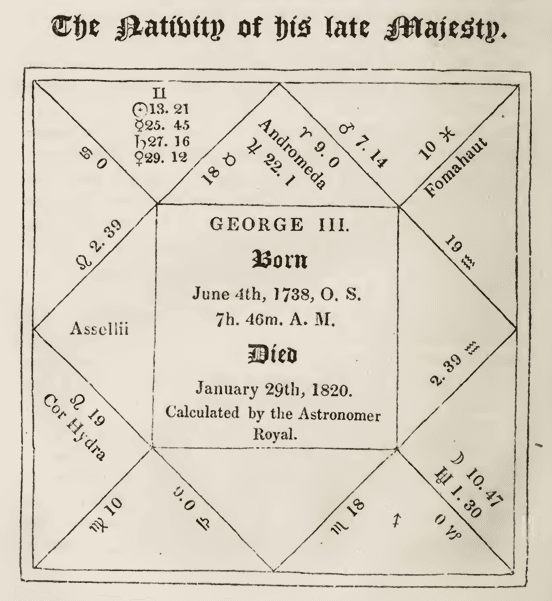
The chart, labeled with the intriguing title “The Rativity of his late Majesty,” was calculated by “the ingenious Mr. Charles Brent” and bears the distinction of having been computed by no less an authority than the Astronomer Royal. Its format—a diamond-shaped (or square) horoscope rather than the circular charts familiar to modern astrologers—immediately signals its historical pedigree. This distinctive visual presentation, known as a diamond chart or square horoscope, was the preferred format among English astrologers from the 17th through the 19th centuries, representing a unique chapter in the evolution of astrological charting.
This article explores the George III diamond horoscope in exhaustive detail, examining its historical context, technical methodology, visual characteristics, and the astrological techniques it embodies. We will compare this remarkable artifact with modern charting practices, demonstrating how the 18th-century approach differed fundamentally from contemporary methods while still offering invaluable insights for students of traditional astrology.
Historical Context: Astrology in 18th-Century England
The Golden Age of English Astrology
The 18th century represents a fascinating period in the history of Western astrology. While the scientific revolution had begun to challenge astrological worldviews, astrology in England remained a respected intellectual pursuit, practiced by scholars, physicians, and gentlemen of learning. The century witnessed the publication of some of the most influential astrological works in the English language, building upon the foundations laid by William Lilly in the previous century.
Ebenezer Sibly (1751–1800), the publisher of George III’s chart, stands as one of the most significant figures of this period. A physician, Freemason, and prolific author, Sibly represents the fascinating intersection of Enlightenment rationalism and occult tradition that characterized late 18th-century intellectual life. His magisterial work, The New and Complete Illustration of the Celestial Science of Astrology, remains a cornerstone of traditional astrological literature, preserving techniques and methodologies that might otherwise have been lost.
Sibly’s intellectual breadth was remarkable. While deeply convinced of the need to search for truth in the works of alchemists, natural magicians, and astrologers, he also engaged seriously with the most recent scientific journals of his day. Figures like Heberden, Newton, Priestley, and Lavoisier were no less important to him than Aristotle, Hermes Trismegistus, and Paracelsus. This synthesis of ancient wisdom and modern science perfectly encapsulates the transitional nature of 18th-century astrology.
The Astronomer Royal and the Chart’s Calculation
The notation that George III’s chart was “Calculated by the Astronomer Royal” carries profound significance. The office of Astronomer Royal, established in 1675 with the founding of the Royal Observatory at Greenwich, represented the pinnacle of British astronomical authority. By the 18th century, the Astronomer Royal was responsible for the nation’s most accurate ephemerides and astronomical tables.
The fifth Astronomer Royal, Nevil Maskelyne (1732–1811), held the office from 1765 to 1811 and created the Nautical Almanac and Astronomical Ephemeris, which became the standard reference for both navigation and astrology. It was likely Maskelyne’s tables—or those of his predecessors John Flamsteed and Edmond Halley—that provided the astronomical data for Brent’s calculations.
The involvement of the Astronomer Royal in casting a royal horoscope underscores the close relationship between astronomy and astrology that persisted well into the 18th century. While today these disciplines are sharply divided, in George III’s time they shared methods, tables, and often practitioners.
The Birth Data
George III was born on June 4, 1738 (Old Style—the Julian calendar still in use in England at the time), at Norfolk House, St. James’s Square, Westminster, London. Sibly’s source gives the time as “May 24th; 7 Hrs, 5 min, 10”; AM, 1738″—the discrepancy in dates reflecting the difference between the Julian and Gregorian calendars. The location is given as “Lat. 53°”.
Modern calculations place George III’s birth at 7:30 AM local time, yielding an Ascendant of 0°19′ Leo and a Midheaven of 5°33′ Aries. The Sun was at 13°20′ Gemini, and the Moon at 10°47′ Capricorn.
The Diamond Horoscope: Format and Visual Characteristics
Origins of the Diamond Format
The diamond or square horoscope format, while unfamiliar to most modern astrologers, was the predominant chart style in England from the 17th through the 19th centuries. Its origins can be traced to the practical needs of astrologers who calculated charts by hand and required a format that was efficient to draw and easy to read.

Unlike the circular charts that dominate modern astrology, the diamond format arranges the twelve houses in a square or diamond pattern. The houses are typically drawn as a series of interconnected diamond shapes, with the signs of the zodiac distributed around the perimeter. Planets are written within the compartments corresponding to their house positions.
Visual Analysis of the George III Chart
The George III diamond chart exhibits several distinctive visual characteristics that mark it as a product of its time:
1. Diamond-Shaped House Layout
The houses are arranged in a diamond pattern, with the Ascendant typically positioned at the left or top-left point of the diamond. This arrangement emphasizes the house structure, making it immediately apparent in which house each planet resides.
2. Signs Distributed Around the Figure
The twelve signs of the zodiac are placed around the perimeter of the diamond, often with their ruling degrees indicated. This allows the astrologer to quickly determine the sign position of any planet.
3. Planets Written Within Compartments
Each planet is written inside the compartment corresponding to its house, typically accompanied by its degree and minute position within the sign. For example, the Sun is recorded as “13°21′”.
4. Fixed Stars Prominently Featured
One of the most remarkable features of the George III chart is its inclusion of important fixed stars. Brent incorporated the influence of stars such as Aldebaran (with the Sun), Regulus (with Caput), and others. This practice, central to classical astrology, has largely fallen out of use in modern practice.
5. Minimal Aspect Drawing
Unlike modern charts that feature colorful aspect lines connecting planets, the diamond format typically includes few or no drawn aspects. Aspects were calculated mentally or recorded separately.
The Significance of Fixed Stars
The inclusion of fixed stars in the George III chart deserves particular attention. In traditional astrology, fixed stars were considered to have potent influences that could modify or amplify planetary effects. Stars like Aldebaran (the “Eye of the Bull”), Regulus (the “Heart of the Lion”), and Fomalhaut were believed to confer specific qualities based on their nature and magnitude.
Download the Astral Lens.
The astrological tool for the Android system
Sibly himself commented on the stars in George III’s chart, noting that “Aldebaran is with the Sun, Regulus with Caput”. The conjunction of Aldebaran with the Sun would have been interpreted as bestowing royal dignity and leadership qualities, while Regulus with Caput (the head of the constellation) reinforced themes of authority and command.
Today, few astrological software programs automatically display fixed stars, making charts like this one valuable historical records of a once-central astrological practice.
Technical Methodology: How the Chart Was Calculated
Ephemerides and Astronomical Tables
The calculation of George III’s horoscope would have begun with the consultation of astronomical tables known as ephemerides. These tables provided the daily positions of the planets, allowing the astrologer to interpolate positions for the exact time of birth.
In 18th-century England, the most authoritative ephemerides were those produced by the Astronomer Royal and his predecessors:
- Flamsteed’s tables: John Flamsteed (1646–1719), the first Astronomer Royal, produced extensive star catalogues and planetary tables.
- Halley’s tables: Edmond Halley (1656–1742), the second Astronomer Royal, published star catalogues and cometary observations.
- Maskelyne’s Nautical Almanac: Nevil Maskelyne’s annual publication provided the most accurate planetary positions available.
The astrologer would have used these tables to determine the geocentric longitudes of the Sun, Moon, and planets for the birth moment, accounting for their daily motion.
Local Time and the Greenwich Meridian
A crucial consideration in 18th-century chart calculation was the absence of standardized time. Greenwich Mean Time (GMT) did not exist as a standard until the late 19th century. Instead, astrologers used Local Apparent Time (LAT)—the time indicated by a sundial at the birth location.
For George III’s chart, the birth time of 7:05:10 AM would have been local apparent time for London. The conversion to the meridian of the Royal Observatory at Greenwich (only a few degrees away) would have been a minor adjustment, but the principle of local time was essential for accurate house cusp calculation.
Calculating the Ascendant and Midheaven
The Ascendant (rising sign) and Midheaven (Medium Coeli or MC) were calculated manually using trigonometric tables. The process involved:
- Determining the Sidereal Time of birth
- Using tables of houses for the appropriate latitude
- Interpolating between values for the exact birth time
The George III chart shows an Ascendant in Leo and a Midheaven in Aries, consistent with modern calculations.
The House System: Regiomontanus
The choice of house system represents one of the most significant technical decisions in chart calculation. For the George III chart, the evidence strongly points to the Regiomontanus system.
The Regiomontanus system, named after the German mathematician and astrologer Johannes Müller (1436–1476), divides the celestial equator into twelve equal segments. Great circles are then drawn from the North point through these segment points to the South point, and the house cusps are formed by the intersections of these circles with the ecliptic.
Regiomontanus was the preferred house system in England after William Lilly, whose monumental work Christian Astrology (1647) established it as the standard for horary and natal astrology. Lilly’s influence on English astrology was so profound that his methodological choices became de facto standards for generations.
Other possibilities include the Campanus system (which divides the prime vertical) or the Placidus system (which was beginning to gain popularity but was not yet dominant). However, given the English astrological tradition of the period and the influence of Lilly, Regiomontanus is by far the most likely choice.
Planetary Longitudes
The positions in the George III chart are recorded in the standard format: sign, degrees, and minutes. For example, the Sun is given as “13°21′”—meaning 13 degrees and 21 minutes of the sign in which it is placed. This precise notation reflects the astrologer’s commitment to accuracy and the availability of detailed ephemerides.
Manual Calculation: A Lost Art
It is difficult for modern astrologers, accustomed to instant chart generation by software, to appreciate the labor involved in 18th-century chart calculation. Each chart required:
- Consulting multiple tables and ephemerides
- Performing arithmetic for planetary positions
- Calculating house cusps using spherical trigonometry
- Determining planetary aspects manually
- Recording all data clearly and legibly
The George III chart, like all charts of its era, was the product of careful, painstaking calculation—a process that could take hours and required considerable mathematical skill.
Astrological Techniques Employed
Traditional Natal Astrology
The George III chart was undoubtedly intended for traditional natal astrology, also known as genethliacal astrology. This approach, rooted in the works of Ptolemy and refined by medieval and Renaissance astrologers, focused on:
- Essential dignities: The inherent strength or weakness of planets based on sign placement (domicile, exaltation, detriment, fall)
- Accidental dignities: Strength derived from house placement, aspects, and other factors
- Receptions: Mutual exchanges between planets via rulership
- Almuten: The planet with the most dignity at a given point
- Lord of the chart: The planet that rules the Ascendant
- Fixed stars: The influence of notable stars on planets and chart angles
What Was NOT Included
Equally revealing is what the George III chart does not include:
- Asteroids: Unknown in 18th-century astrology
- Chiron: Discovered only in 1977
- Modern Lilith: A 20th-century concept
- Transpersonal planets: Uranus (discovered 1781), Neptune (1846), Pluto (1930)
- Aspect lines: Aspects were calculated, not drawn
- Aspect tables: Recorded separately if at all
- Dignity tables: Calculated separately
- Planetary speed: Calculated separately
- Ecliptic latitude: Recorded separately if needed
- Declination: Recorded separately if needed
This minimalist approach to chart presentation reflects the traditional focus on house placement and sign position rather than visual pattern recognition.
Horary Astrology Connection
The diamond format was particularly well-suited to horary astrology—the art of answering specific questions by casting a chart for the moment of the question. William Lilly, the great master of horary astrology, used a very similar format. The clear delineation of houses made it easy to identify the significators for different areas of life, which is central to horary interpretation.
Advantages of the Diamond Format
1. Exceptional Clarity
The diamond format provides an exceptionally clean visual presentation. With minimal information on the page, the astrologer’s eye is drawn immediately to:
- House positions
- Sign placements
- Planetary locations
This clarity was essential for rapid interpretation, particularly in horary work where time was often of the essence.
2. Emphasis on Houses
The diamond layout emphasizes house structure above all else. In traditional astrology, the houses represent the primary framework for interpretation—each house governs specific areas of life. The diamond format makes it instantly apparent in which house each planet resides, facilitating quick assessment of planetary influence on different life domains.
3. Efficiency for Hand Calculation
In an era when all charts were drawn by hand, the diamond format offered significant practical advantages. It could be drawn quickly and consistently, allowing astrologers to produce dozens of charts in a single session. The geometric simplicity of the diamond layout made it far easier to reproduce accurately than a circular chart with its more complex construction.
4. Strong Traditional Pedigree
The diamond format follows the logic of classical astrology without modern influences. It preserves the interpretive framework used by astrologers from Ptolemy through Lilly, making it ideal for students of traditional techniques.
5. Fixed Star Integration
The diamond format readily accommodates the inclusion of fixed stars, which were central to traditional practice but have been largely forgotten in modern astrology. The George III chart’s prominent display of stars like Aldebaran and Regulus exemplifies this traditional emphasis.
Disadvantages of the Diamond Format
1. Aspect Visualization Difficulties
Perhaps the greatest limitation of the diamond format is the difficulty of visualizing aspects. Modern astrologers have become accustomed to circular charts with colorful aspect lines that make trines, squares, sextiles, and oppositions immediately apparent. In the diamond format, aspects must be calculated mentally or recorded separately—a slower and more error-prone process.
2. Reduced Visual Intuition
The diamond format does not easily convey the intuitive visual patterns that modern astrologers rely on. Configurations like Grand Trines, T-Squares, and Stelliums are not immediately obvious in the diamond layout. The geometric relationships that give circular charts their visual power are largely absent.
3. Unfamiliar to Modern Students
For students trained on circular charts, the diamond format appears strange and counterintuitive. The learning curve is significant, requiring the student to develop new visual habits and mental models for chart interpretation.
4. Difficulty in Chart Comparison
Synastry (chart comparison) and composite charts are considerably more difficult with diamond format charts. The lack of visual aspect lines makes it challenging to quickly assess relationships between planets in different charts.
5. Limited Geometric Awareness
The diamond format obscures the celestial geometry that is so apparent in circular charts. Concentrations of planets, patterns, and configurations are not visually emphasized, requiring the astrologer to work harder to perceive these important features.
Comparison: Diamond Chart vs. Modern Circular Chart
| Feature | Diamond Chart (18th Century) | Modern Circular Chart |
|---|---|---|
| Shape | Diamond/Square | Circle |
| House Emphasis | Very prominent | Prominent |
| Aspects | Not drawn; calculated mentally | Drawn with colored lines |
| Fixed Stars | Frequently included | Rarely included |
| Ease for Beginners | Low | High |
| Traditional Astrology | Excellent | Good |
| Psychological Astrology | Limited | Excellent |
| Visual Readability | Moderate | Very high |
| Aspect Pattern Recognition | Poor | Excellent |
| Hand Calculation Ease | Excellent | Poor |
Astronomical Precision: Then and Now
The precision of 18th-century astrological charts depended entirely on the quality of available ephemerides. For the Sun, Moon, and visible planets, the errors could vary from a few minutes to fractions of a degree—sufficient for traditional astrological interpretation.
Today, modern ephemerides based on sophisticated computational models provide vastly superior accuracy:
- VSOP87: Planetary theory for the Sun and planets
- ELP2000: Lunar theory
- DE440: Jet Propulsion Laboratory’s Development Ephemeris
- IAU 2006/2000A: Corrections for precession and nutation
These modern models provide precision measured in arcseconds, far exceeding anything available in the 18th century. This is particularly important for the calculation of the Ascendant, Midheaven, and lunar positions, which are sensitive to small errors.
The George III Chart in Context: Sibly’s Commentary
Ebenezer Sibly’s commentary on George III’s chart offers fascinating insight into the interpretative approach of 18th-century astrologers. Sibly writes with evident caution, noting that “Were I to enter minutely into a calculation of this nativity, the event might be prejudicial to many, and draw upon me the contempt of some and the resentment of others”. This diplomatic restraint reflects the delicate position of astrologers commenting on the charts of living monarchs.
Despite his caution, Sibly offers revealing interpretations:
“Upon the oriental horizon of this illustrious geniture, we find the noble and princely sign Leo ascending, with Caput Algol and the benefic Jupiter most gloriously elevated in the medium-coeli, the house of kingly honour, eminence, and unbounded sovereignty”
The Ascendant in Leo, the sign of kings, is noted as appropriate for royalty. The presence of Jupiter (the greater benefic) in the Midheaven (the house of honor and sovereignty) is interpreted as an emblem of “that universal joy, of that glory, honour, and renown, wherewith his majesty most deservedly ascended the British throne”.
Sibly also comments on the “congress formed in the eleventh house”—a configuration of planets in the house of friends, allies, and hopes. He invites “every scientific reader” to examine this configuration and “make out, by the rules heretofore given, a pretty correct presage of all the principal public occurrences that have happened during the present reign”.
This commentary exemplifies the traditional approach to natal interpretation: planets are assessed by house placement, essential dignity, and configuration with other planets and fixed stars.
Historical Significance
The George III diamond horoscope represents a crucial phase in Western astrology’s evolution. It embodies a moment when:
- Astronomy and astrology still shared methods: The Astronomer Royal’s tables were used for both scientific and astrological purposes
- Calculations were entirely manual: Every chart was the product of painstaking hand calculation
- Traditional interpretation reigned supreme: The focus was on houses, regencies, dignities, and fixed stars
- Graphical presentation prioritized clarity of placement over geometric visualization of aspects
For students of traditional astrology, this format remains invaluable, preserving the interpretive logic used by classical astrologers like William Lilly. For modern and psychological astrology, the circular chart has become predominant, offering faster visual reading of angular relationships and chart configurations.
Conclusion
The diamond horoscope of King George III, cast by Charles Brent and published by Ebenezer Sibly, stands as a remarkable artifact of 18th-century astrological practice. Its distinctive format, meticulous calculation, and inclusion of fixed stars offer a window into a world where astrology and astronomy were still intimately connected, where charts were calculated by hand with painstaking precision, and where traditional interpretive techniques held sway.
While modern astrologers have largely abandoned the diamond format in favor of circular charts with their intuitive aspect lines and visual patterns, the George III chart reminds us of the rich heritage of Western astrology. It demonstrates that before the advent of computers and standardized time, astrologers produced sophisticated, accurate charts using nothing more than tables, mathematics, and skill.
For those who study traditional astrology, the diamond format remains an invaluable tool, preserving the interpretive logic that has guided astrologers for centuries. And for all students of astrology, the George III chart serves as a powerful reminder of the discipline’s long and fascinating history—a history in which kings and commoners alike sought to understand their destinies through the language of the stars.
References
- Sibly, Ebenezer. A New and Complete Illustration of the Celestial Science of Astrology. London, 1790s.
- Skyscript. “Ebenezer Sibly’s Historical Horoscopes.” www.skyscript.co.uk/sibly.html.[reference:65]
- Skyscript. “Horoscope for GEORGE III. KING OF GREAT BRITAIN.” www.skyscript.co.uk/sib_GeorgeIII.html.[reference:66]
- Album Online. “ASTROLOGY – HOROSCOPES. The birth-chart of King George III of England.” www.album-online.com.[reference:67]
- Astrotheme. “George III du Royaume-Uni birth chart.” www.astrotheme.com.[reference:68]
- Wikipedia. “Nevil Maskelyne.” en.wikipedia.org.
- Wikipedia. “Christian Astrology.” en.wikipedia.org.
- Debus, Allen. The Chemical Philosophy. As cited in Skyscript’s biography of Ebenezer Sibly.
- Kirby, Richard and Bishop, John. The Marrow of Astrology. London, 1687.
- Ptolemy, Claudius. Tetrabiblos. Various editions.
Download the Astral Lens.
The astrological tool for the Android system